
From sample to information.
Between a biodiversity question and information for a project lies a sequence of choices. Study design guides sampling, the molecular approach and interpretation.
Explore each step.
Select a step to understand what happens and what guides the choices. The process is tailored to the study question and scope.
01QuestionIt all starts with a question.
- What happens at this step
- The study objective guides all methodological choices. It is necessary to define what needs to be detected, compared or understood.
- What needs to be defined
- The required precision, spatial scale and decision context influence the design. Comparisons across locations or sampling campaigns require compatible planning.
- What MetaGen assesses or performs
- Discusses the possibilities and limitations of the approaches based on the study question and scope, before sampling.

The environment and the question guide sampling design. 02SamplePreserve the material. Record the context.
- What happens at this step
- Water, soil, sediment or tissue may carry the information needed. Sample type selection follows the approach: not every analysis is suitable for every sample type.
- What needs to be defined
- Sample type, locations, replication, preservation and metadata are defined according to the study scope and design. Traceability of sample identification must be maintained.
- What MetaGen assesses or performs
- Aligns sampling requirements with the planned analysis and considers the records and condition of the material received during interpretation. Sampling activities and responsibilities are defined in the scope.
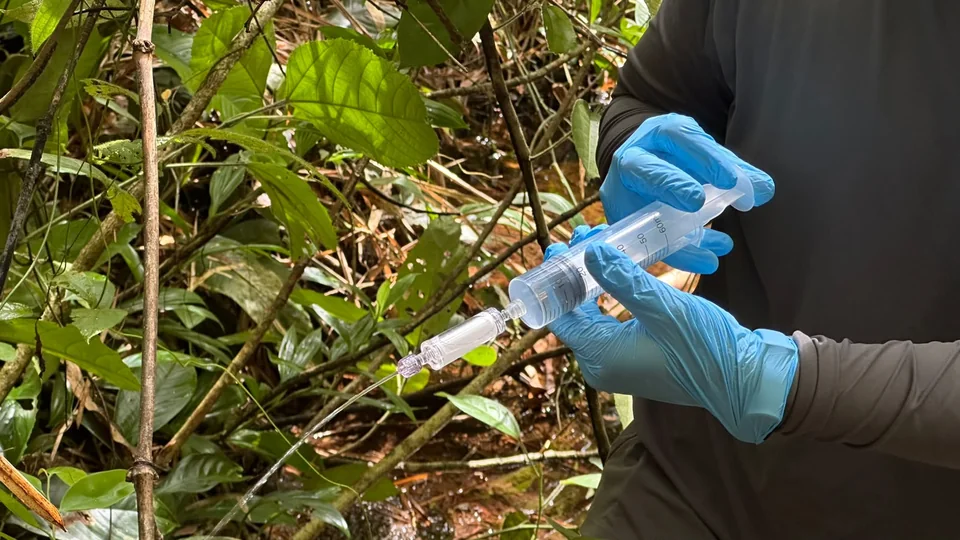
Water filtration. Other sample types require their own procedures. 03ExtractionFrom sample to genetic material.
- What happens at this step
- DNA is isolated from the sample in a controlled environment. Controls help identify potential contamination.
- What needs to be defined
- Sample type and preservation conditions guide the procedures. The quantity and quality of the material may influence subsequent steps.
- What MetaGen assesses or performs
- Assesses the material and performs DNA preparation and the controls defined for the sample type and scope, without a single sequence applicable to all studies.
04Molecular analysisThe approach follows the objective.
- What happens at this step
- The question can lead to different molecular approaches. No technique is universally superior: each approach has possibilities and limitations.
- What needs to be defined
- Organisms of interest, sample type, markers or targets and the information needed guide the choice, according to the design and scope.
- What MetaGen assesses or performs
- Assesses the suitability of the approach and performs the planned analyses. The four approaches below continue to data processing and interpretation.
Four approaches, one common foundation
- Environmental DNA (eDNA) and metabarcoding
Investigation of groups of organisms according to sample type, markers and references.
- qPCR
Detection of a defined target and quantification when applicable to the scope.
- DNA barcoding
Molecular identification of specimens by comparison with references.
- Population genetics and genomics
Questions about diversity, structure and connectivity.
All continue to 05 / Data and 06 / Information. Bioinformatics contributes to data processing according to the approach.
05DataData need context.
- What happens at this step
- Molecular data are processed according to the approach. When sequencing is involved, they go through bioinformatics steps. Not every molecular analysis includes sequencing.
- What needs to be defined
- Reference databases, filters, parameters and controls influence interpretation. Data quality and records need to accompany processing.
- What MetaGen assesses or performs
- Organizes the data and applies the relevant analytical criteria, recording steps and parameters. Bioinformatics incorporates sequence processing and, where applicable, taxonomic assignment.
06InformationThe result returns to the question.
- What happens at this step
- The result needs to answer the original question. Methods, criteria and limitations remain explicit, alongside the other study data.
- What needs to be defined
- The information format and level of interpretation are defined according to the study scope and design.
- What MetaGen assesses or performs
- Interprets and organizes the evidence within the agreed scope. Detecting DNA does not automatically allow inferences about abundance, population size or the presence of a living individual; these inferences require support from the specific approach. Non-detection does not prove absolute absence.
Further reading on environmental DNA
References supporting the eDNA approach, unrelated to MetaGen results or projects.
From question to study design.
Tell us about the project objective so we can discuss the molecular approach and analytical scope.